Expert Buyer’s Guide to Volkswagen Electric SUVs in 2025: 4 Key Factors vs. Rivals
Dezembro 18, 2025
Resumo
This analysis provides a comprehensive examination of Volkswagen's electric SUV lineup for the 2025 model year, focusing on their viability for import into emerging markets such as South America, Russia, Southeast Asia, the Middle East, and South Africa. The primary models discussed are the ID.4, ID.5, and ID. Buzz, all built upon the modular electric drive matrix (MEB) platform. The study evaluates these vehicles across four critical factors: real-world battery range and performance under varied climatic conditions; charging speed and infrastructure compatibility; total cost of ownership, including import duties and maintenance; and onboard technology and user experience. A comparative analysis situates these Volkswagen electric SUVs against formidable competitors, notably Tesla and rapidly expanding Chinese manufacturers like BYD. The findings suggest that while Volkswagen offers robust engineering and strong brand equity, prospective buyers must weigh these attributes against the aggressive pricing, and in some cases, superior battery technology offered by rivals in a fiercely competitive global EV market.
Principais conclusões
- Evaluate the ID.4 for practicality, the ID.5 for style, and the ID. Buzz for unique utility.
- Assess real-world range based on your local climate, as performance varies significantly.
- Analyze the total cost of ownership, not just the initial purchase and import price.
- Compare Volkswagen electric SUVs against rivals like BYD for value and features.
- Verify local charging standards and service availability before committing to an import.
- Partner with a trusted exporter to navigate complex homologation and shipping logistics.
- Consider software maturity and over-the-air update capabilities for long-term satisfaction.
Índice
- The Volkswagen Electric SUV Lineup: An Introduction to the ID. Family
- Factor 1: Real-World Range and Battery Performance
- Factor 2: Charging Infrastructure and Speed
- Factor 3: Total Cost of Ownership and Value Proposition
- Factor 4: Technology, Software, and User Experience
- Navigating the Import Process for Volkswagen Electric SUVs
- The Competitive Landscape in 2025
- Perguntas frequentes (FAQ)
- Conclusão
- Referências
The Volkswagen Electric SUV Lineup: An Introduction to the ID. Family
To comprehend the offerings of Volkswagen electric SUVs in 2025 is to understand a fundamental shift in the strategy of one of the world's automotive titans. The "ID." family represents more than just a series of new models; it signifies a deep, structural commitment to an electric future. This commitment is built, quite literally, on a shared foundation: the Modularer E-Antriebs-Baukasten, or MEB platform.
The MEB Platform: The Foundation of VW's Electric Ambition
Think of the MEB platform as a sophisticated, standardized skateboard. The base of this skateboard holds the battery pack, flat and low, which provides a low center of gravity for improved handling and stability. On top of this base, electric motors are mounted at the rear or both front and rear axles. The genius of this modular approach is its flexibility. By stretching or shortening the wheelbase (the distance between the front and rear wheels) and fitting different "top hats"—the vehicle bodies—Volkswagen can create a diverse range of vehicles, from a compact hatchback to a spacious van, all while sharing core components. This streamlines production, reduces costs, and accelerates development. For you, the buyer, this means that whether you are looking at an ID.4 or an ID. Buzz, you are benefiting from the same fundamental, rigorously tested electric architecture.
The ID.4: The Global Contender
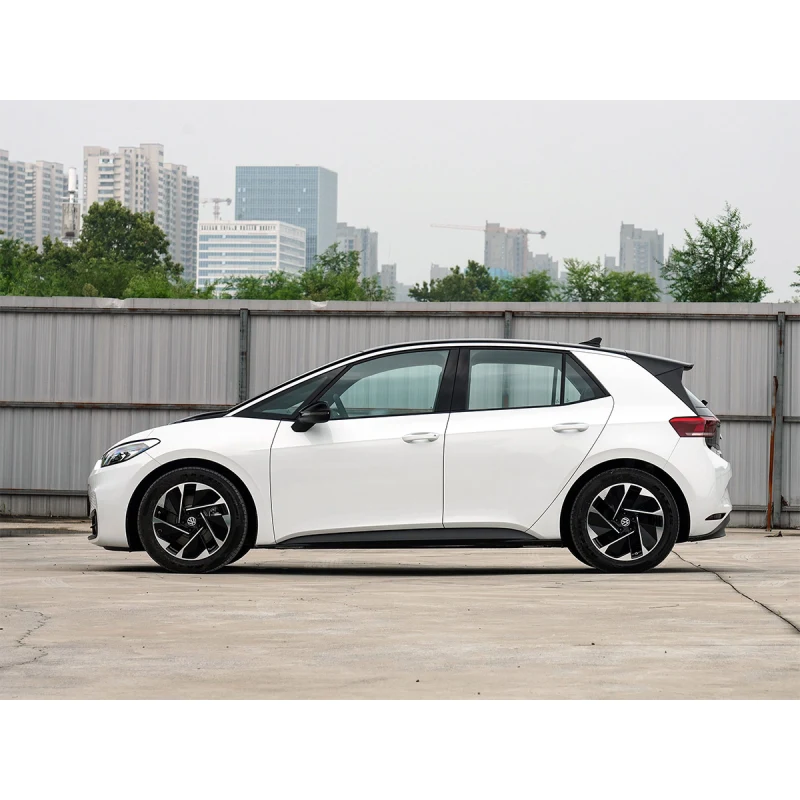
The ID.4 is Volkswagen's spearhead in the global electric SUV market. It is designed to be the "people's electric car," a versatile, practical, and approachable vehicle for families and individuals alike. Its design is clean and aerodynamic, avoiding aggressive lines for a more universally appealing look. Inside, the cabin is spacious and airy, a direct benefit of the MEB platform, which eliminates the need for a transmission tunnel and allows for a longer wheelbase relative to its overall length. The ID.4 is offered with various battery and motor configurations, allowing buyers to prioritize either maximum range or all-wheel-drive performance. It is the pragmatic choice, the logical entry point into the world of Volkswagen electric SUVs.
The ID.5: Style Meets Substance
What if you desire the practicality of the ID.4 but crave a more dynamic and stylish silhouette? For this, Volkswagen created the ID.5. Mechanically, the ID.5 is nearly identical to the ID.4. It shares the same platform, batteries, and motors. The primary difference is its roofline. The ID.5 features a sloping, coupe-like rear, which gives it a sportier and more elegant profile. This design choice slightly reduces rear headroom and maximum cargo capacity compared to its boxier sibling, but for many buyers, the aesthetic trade-off is well worth it. It is often positioned with a slightly more premium set of standard features, targeting a buyer who values form as much as function.
The ID. Buzz: Nostalgia Electrified
The ID. Buzz is the emotional heart of the ID. family. It is a modern reinterpretation of the iconic Type 2 Microbus, a vehicle that symbolizes freedom and adventure for generations. The ID. Buzz brilliantly merges retro design cues—like its two-tone paint options and friendly "face"—with the futuristic underpinnings of the MEB platform. It is available as both a passenger van, offering immense interior space for families or lifestyle-oriented buyers, and a cargo van for commercial use. The ID. Buzz is not just a vehicle; it is a statement piece. It demonstrates that electric mobility can be characterful, fun, and deeply rooted in a brand's heritage.
To better visualize the core differences, let's compare the key specifications of these three models.
| Caraterística | Volkswagen ID.4 | Volkswagen ID.5 | Volkswagen ID. Buzz |
|---|---|---|---|
| Tipo de veículo | SUV compacto | Compact Coupe-SUV | Electric Minivan/Van |
| Primary Focus | Practicality, All-Round Use | Style, Sporty Design | Space, Utility, Nostalgia |
| Battery Options | 58 kWh / 77 kWh (net) | 77 kWh (net) | 77 kWh (net) / 86 kWh (net, LWB) |
| Sistema de tração | RWD / AWD | RWD / AWD | RWD / AWD |
| Max Cargo (seats down) | ~1,575 liters | ~1,561 liters | ~2,205 liters (SWB) |
| Target Buyer | Families, pragmatic EV adopters | Design-conscious individuals | Large families, businesses, lifestyle |
Factor 1: Real-World Range and Battery Performance
Perhaps the most persistent question surrounding any electric vehicle is, "How far will it go on a charge?" For anyone considering importing one of the Volkswagen electric SUVs, this question is not merely academic; it is a practical consideration that will shape the daily usability of the vehicle. The answer is nuanced, depending on everything from official test cycles to the climate of your specific region.
Understanding WLTP vs. EPA vs. Real-World Conditions
When you see a range figure advertised, it is typically based on a standardized testing procedure. The two most common are the Worldwide Harmonised Light Vehicle Test Procedure (WLTP), used in Europe and other parts of the world, and the Environmental Protection Agency (EPA) test in the United States. WLTP figures tend to be more optimistic than EPA figures, which are generally considered closer to what a driver might experience in mixed driving.
However, neither of these lab-based tests can fully replicate the conditions you will face. Think of them as a useful baseline for comparison, not an absolute guarantee. Real-world range is impacted by driving style (aggressive acceleration consumes more energy), terrain (driving uphill requires significant power), payload (a fully loaded car has less range), and, most critically, ambient temperature.
Battery Technology: Cell Chemistry and Thermal Management
At the heart of range performance is the battery itself. Volkswagen's ID. models primarily use Nickel Manganese Cobalt (NMC) battery chemistries in their larger packs, which offer a good balance of energy density and power output. The battery pack is not just a box of cells; it is a complex system with a sophisticated thermal management system. This system uses liquid cooling and heating to keep the battery within its optimal temperature range (typically 20-40°C). An effective thermal management system is vital for both performance and longevity. It allows for faster charging and helps mitigate the negative effects of extreme temperatures on range and battery health.
How Climate Affects Range: A Guide for Hot and Cold Regions
This is where empathy for the buyer's context is paramount. A driver in Dubai faces different challenges than one in Moscow.
-
Hot Climates (Middle East, Southeast Asia, parts of South America): Extreme heat can be just as detrimental to range as cold. While the battery chemistry itself performs well in warmth, the car must expend significant energy to cool both the battery pack and the cabin via the air conditioning system. This constant load from the AC can reduce real-world range by 15-20% or more compared to temperate conditions. The good news is that VW's liquid-cooling system is robust and designed to protect the battery from overheating, which is critical for long-term health.
-
Cold Climates (Russia, Northern regions): Cold is the well-known enemy of EV range. Battery chemistry becomes sluggish, reducing the amount of energy that can be discharged. Furthermore, a great deal of energy is required to heat the battery to its operating temperature and to warm the cabin for the occupants. This "winter penalty" can be substantial, with range reductions of 30-40% or even more in freezing conditions. Volkswagen equips its vehicles with efficient heat pump systems (often as an option), which are much more efficient at generating warmth than simple resistive heaters, helping to preserve precious range in the winter.
Competitive Analysis: How VW Stacks Up Against Rivals like BYD
The EV landscape in 2025 is no longer dominated by just one or two players. The rise of Chinese manufacturers, particularly BYD, has introduced intense competition. BYD has become the world's top EV seller, a testament to its advanced technology and aggressive pricing (). A key differentiator for BYD is its "Blade Battery" technology. This LFP (Lithium Iron Phosphate) battery chemistry is known for its exceptional safety profile and long cycle life. While traditionally having lower energy density than NMC, BYD has pushed the technology forward to offer competitive range.
Let's compare the Volkswagen ID.4 with two of its fiercest competitors in the global market: the Tesla Model Y and the BYD Song Plus EV.
| Model (Typical Long-Range RWD Version) | Battery (Net) | WLTP Range (Est.) | Key Battery Technology |
|---|---|---|---|
| Volkswagen ID.4 Pro | 77 kWh | ~530 km | NMC Chemistry, Prismatic Cells |
| Tesla Model Y Long Range RWD | ~75 kWh | ~600 km | NCA/NMC Chemistry, Cylindrical Cells |
| BYD Song Plus EV Champion Edition | 87 kWh | ~605 km | LFP Chemistry, "Blade Battery" |
This table illustrates the challenge Volkswagen faces. While the ID.4's range is very respectable and more than sufficient for most users, competitors like Tesla and BYD are pushing the boundaries, often offering more range for a similar or lower price. The choice for a buyer then becomes about more than just the maximum number; it involves considering the brand's reputation for build quality, the driving dynamics, and the after-sales support network, areas where Volkswagen has traditionally held a strong advantage.
Factor 2: Charging Infrastructure and Speed
If range is the first question, "How long does it take to charge?" is inevitably the second. The experience of "refueling" an electric vehicle is fundamentally different from that of a gasoline car, and understanding the nuances of charging is essential for a satisfying ownership experience, especially when importing a vehicle into a market with a developing charging network.
AC vs. DC Fast Charging: What You Need to Know
Charging an EV can be broken down into two main types: AC (Alternating Current) and DC (Direct Current).
-
AC Charging: This is the type of electricity that comes from a standard wall outlet. When you use a home charger (wallbox) or a public Level 2 charger, you are using AC power. The car's onboard charger then converts this AC power to DC to fill the battery. The speed is limited by the power of the wallbox and the capacity of the car's onboard charger (typically 7.4 kW or 11 kW on Volkswagen electric SUVs). AC charging is perfect for overnight top-ups at home or for several hours at the workplace. An 11 kW charger can fully replenish an ID.4's 77 kWh battery from empty in about 7.5 hours.
-
DC Fast Charging: This is what you use for long-distance travel. DC chargers are large, high-powered stations that bypass the car's onboard charger and feed DC power directly into the battery. This allows for much faster speeds. The ID.4, for example, can charge at speeds of up to 170 kW on a compatible DC fast charger. At this speed, it can hypothetically go from a 10% to 80% state of charge in around 30 minutes, adding hundreds of kilometers of range in the time it takes to have a coffee break.
VW's Charging Curve: The Importance of Sustained Speed
The "peak" charging speed (like the 170 kW figure) is only part of the story. What is arguably more important is the charging curve. This is a graph that shows how the charging speed changes as the battery fills up. An ideal curve would hold the peak speed for as long as possible before gradually tapering off as the battery approaches full.
Imagine two cars, Car A and Car B. Car A has a peak speed of 200 kW but only holds it for two minutes before dropping to 80 kW. Car B has a peak speed of 170 kW but sustains that speed for 15 minutes before gradually decreasing. Over a 30-minute session, Car B will have added significantly more energy to its battery. Volkswagen has engineered its ID. models to have a relatively flat and stable charging curve, prioritizing consistent and predictable charging performance over a headline-grabbing but short-lived peak. This is a hallmark of solid German engineering—focusing on real-world usability over marketing specifications.
Navigating Charging Standards in Emerging Markets
This is a critical consideration for importers. Unlike the standardized nozzle for gasoline, DC fast charging has several competing plug standards.
- CCS2 (Combined Charging System): This is the standard in Europe, and the one that Volkswagen electric SUVs are equipped with from the factory. It is also becoming the dominant standard in many other regions, including parts of the Middle East and Southeast Asia.
- CHAdeMO: This standard was developed in Japan and is used by vehicles like the Nissan Leaf. It is less common for new installations but still exists in many regions.
- GB/T: This is the specific DC charging standard for mainland China.
- NACS (North American Charging Standard): Popularized by Tesla, this is now being adopted by many other automakers in North America.
Before you import, it is absolutely vital to research the prevalent DC charging standard in your country. If your country's network is primarily CHAdeMO or GB/T, you will need to find reliable adapters to use public fast chargers, and these adapters can sometimes limit charging speed or reliability. If your region has a growing CCS2 network, a Volkswagen will integrate seamlessly.
The Role of Onboard Chargers and Home Charging Solutions
For the vast majority of your charging (around 80-90%), you will likely rely on AC charging at home or work. The 11 kW onboard charger on most Volkswagen ID. models is robust and more than adequate for this purpose. Investing in a quality wallbox installation is one of the best things you can do to enhance your EV ownership experience. It turns your garage or parking space into your personal fuel station, ensuring you start every day with a full "tank" at a fraction of the cost of public fast charging.
Factor 3: Total Cost of Ownership and Value Proposition
The initial purchase price of an EV is only one chapter in its financial story. To truly assess the value of importing one of the Volkswagen electric SUVs, one must adopt a holistic perspective and calculate the Total Cost of Ownership (TCO). This approach reveals the long-term economic realities of owning the vehicle and provides a more accurate comparison to both internal combustion engine (ICE) cars and other EVs.
Beyond the Sticker Price: Calculating TCO
TCO is a comprehensive calculation that includes several key components over a typical ownership period (e.g., five years):
- Purchase Price & Import Costs: This is the starting point. It includes the vehicle's price from the exporter, shipping fees, insurance, and crucially, any import duties, tariffs, or registration taxes specific to your country. These government-imposed costs can vary dramatically and significantly impact the final on-road price.
- Custos energéticos: This is where EVs shine. Calculate your expected annual mileage and the cost of electricity per kilowatt-hour in your area. Compare this to the cost of fueling a comparable gasoline SUV over the same distance. The savings are often substantial, especially if you primarily charge at home during off-peak hours.
- Maintenance & Servicing: EVs have far fewer moving parts than ICE vehicles. There are no oil changes, spark plugs, exhaust systems, or complex transmissions to service. Maintenance is typically limited to tires, brakes (which last longer due to regenerative braking), suspension components, and cabin air filters. This results in significantly lower routine maintenance costs.
- Seguro: Insurance rates for EVs can sometimes be higher due to the specialized nature of repairs and higher vehicle value. It is wise to get quotes from local insurance providers beforehand.
- Valor de revenda: This is the projected value of the vehicle after your ownership period. Brand strength, battery health, and market perception all play a role. Historically, brands with strong reputations like Volkswagen tend to hold their value well.
Calculating the total cost, including sourcing from a trusted exporter, is a key step. You can explore a range of available Volkswagen models to get an initial idea of pricing and begin your TCO analysis.
Maintenance and Servicing of Volkswagen Electric SUVs
A common concern for importers is the availability of qualified service centers. While the basic maintenance of an EV is simple, any issues with the high-voltage battery or electric drive unit require specialized tools and trained technicians. Before importing, it is prudent to investigate the local landscape. Are there independent EV specialists in your city? Does the official Volkswagen dealer in your country, even if they do not sell the ID. models, have technicians trained on the MEB platform for other markets? Volkswagen's global presence can be an advantage here, as parts and technical knowledge may be more accessible than for less established brands.
Resale Value: A Look into Future Market Trends
Predicting future resale value is always an exercise in educated forecasting. However, several factors work in Volkswagen's favor. The brand's global reputation for quality and durability provides a solid foundation. As markets mature and become more familiar with EVs, vehicles from established automakers are often seen as a safer bet by used car buyers. Furthermore, the longevity of modern battery packs, which are often warrantied for 8 years or 160,000 km to retain at least 70% of their original capacity, helps to alleviate concerns about battery degradation and supports stronger residual values. The global EV market outlook suggests sustained growth, which will create a healthy used market for desirable models like the Volkswagen electric SUVs (IEA, 2025).
Government Incentives and Import Duties in Key Markets
This is a highly localized factor. Some governments, eager to promote EV adoption, offer substantial incentives such as reduced import duties, exemption from registration taxes, or even direct subsidies. Other countries may still levy heavy taxes on all imported vehicles, regardless of powertrain. For example, countries in Southeast Asia like Thailand have been actively promoting EV adoption with tax cuts, making imports more attractive (). In contrast, other markets might have protectionist policies favoring local assembly. A thorough investigation of your country's specific fiscal policies is a non-negotiable step in the TCO calculation.
Factor 4: Technology, Software, and User Experience
In a modern vehicle, the experience is defined as much by the silicon within its screens as the rubber on its wheels. The software, infotainment, and driver-assist systems are no longer peripheral features; they are core to the vehicle's personality and day-to-day usability. For Volkswagen electric SUVs, this has been a journey of evolution.
The Infotainment System: Evolution and Current State
It is fair to say that Volkswagen's initial foray into the all-digital cockpit of the ID. family was met with mixed reviews. Early versions of the software were criticized for being slow, buggy, and having a confusing menu structure. The reliance on capacitive touch sliders for volume and climate control, instead of physical buttons, was a particular point of contention for many users.
However, a critical aspect of modern automotive technology is the ability to improve over time. Through a series of over-the-air software updates, Volkswagen has made significant strides. By 2025, the system is much more responsive, stable, and user-friendly. The latest software versions (ID. Software 4.0 and beyond) feature a more intuitive layout, faster processing, and improved voice commands. While it may not have the minimalist simplicity of a Tesla or the dazzling, screen-filled interiors of some Chinese rivals, it has matured into a capable and functional system that integrates well with features like navigation and charging planning.
Over-the-Air (OTA) Updates: Keeping the Car Modern
The capability for OTA updates is one of the most significant advancements in automotive technology. It means that the vehicle you buy is not static; it can receive new features, performance enhancements, and bug fixes wirelessly, just like your smartphone. Volkswagen is committed to this model, and OTA updates allow them to continuously refine the user experience, improve charging efficiency, and even add new functions to the driver-assist systems long after the car has left the factory. This is a crucial feature for long-term ownership satisfaction, ensuring the vehicle does not feel outdated in a few years.
Driver-Assist Systems (IQ.DRIVE): Safety and Convenience
Volkswagen groups its suite of advanced driver-assistance systems (ADAS) under the brand name IQ.DRIVE. This is not a single feature but a collection of technologies that work together to enhance safety and reduce driver fatigue. Key components include:
- Travel Assist: This is a Level 2 semi-autonomous system that combines Adaptive Cruise Control (ACC) and Lane Keeping Assist. It can automatically manage the vehicle's speed, maintain a set distance from the car ahead, and keep the vehicle centered in its lane, both on highways and in stop-and-go traffic.
- Front Assist: This is the autonomous emergency braking system. It uses radar to monitor the road ahead and can warn the driver of an impending collision and apply the brakes if necessary to mitigate or avoid an impact.
- Side Assist: This is the blind-spot monitoring system, which alerts the driver to vehicles in adjacent lanes.
These systems are generally well-calibrated, providing a confident and reassuring co-pilot on long journeys. They represent Volkswagen's philosophy of using technology to make driving safer and more comfortable, rather than attempting to replace the driver entirely.
Comparing In-Car Tech: VW vs. the Competition
The competitive landscape for in-car technology is diverse.
- Tesla: Sets the benchmark for software fluidity, minimalist design, and an integrated ecosystem. Its single-screen interface is loved by many for its simplicity and responsiveness.
- BYD and other Chinese Brands: Often lead in terms of hardware, featuring large, rotating screens, advanced voice assistants that can control nearly every vehicle function, and a vast array of integrated apps and entertainment options (). The experience can sometimes feel overwhelming, but the sheer number of features is impressive.
- Volkswagen: Aims for a middle ground. The system is more traditional than Tesla's but more restrained than many Chinese offerings. It focuses on core functionality, safety integration, and a clean, modern aesthetic. The choice between these philosophies comes down to personal preference: Do you want a minimalist appliance, a feature-packed entertainment hub, or a solid, well-engineered digital cockpit?
Navigating the Import Process for Volkswagen Electric SUVs
Purchasing a vehicle from overseas introduces a layer of complexity that domestic buyers do not face. For those in South America, the Middle East, or Southeast Asia looking to acquire one of the Volkswagen electric SUVs, understanding and navigating this process is key to a successful transaction.
Understanding Homologation and Regional Standards
Homologation is the process of certifying that a vehicle meets the specific technical, safety, and environmental standards of the country it is being imported into. This can be a complex and bureaucratic procedure. Regulations might govern everything from the color of the indicator lights and the type of headlight beam pattern to specific emissions and safety crash-test certifications. While EVs do not have tailpipe emissions, other regulations still apply. It is crucial to research your country's specific homologation requirements for imported vehicles. Failure to comply can result in the vehicle being denied entry or being unable to be registered for road use.
Sourcing and Logistics: Finding a Reliable Exporter
This is perhaps the most important step in the entire process. A professional and experienced vehicle exporter is not just a seller; they are your logistical partner. Their role is to:
- Source the exact vehicle specification you desire.
- Conduct a thorough pre-shipment inspection.
- Handle all the necessary export documentation from the country of origin.
- Arrange for secure and insured shipping to your nearest port.
- Provide guidance on the documentation needed for customs clearance in your country.
Navigating these complexities is where a professional vehicle exporter provides immense value, ensuring a smooth process for your next Volkswagen electric SUV. A trustworthy partner can save you from costly mistakes, delays, and immense frustration.
Warranty and After-Sales Support in Non-Official Markets
When you import a vehicle into a market where it is not officially sold, this is often referred to as a "grey import." One of the primary considerations here is the manufacturer's warranty. A warranty provided by Volkswagen in Europe will almost certainly not be valid in a country in South Africa if the vehicle was imported privately. This means that if a major component like the battery or drive motor fails, you would be responsible for the full cost of repair.
There are ways to mitigate this risk. Some exporters may offer third-party warranties. Additionally, as mentioned earlier, building a relationship with a local, independent EV specialist is invaluable. They can handle routine maintenance and many common repairs. For major component failures, they may be able to source parts globally and perform the replacement, albeit at a cost. This is a risk that every grey importer must weigh and accept.
The Competitive Landscape in 2025
Choosing one of the Volkswagen electric SUVs in 2025 is not a decision made in a vacuum. The global electric vehicle market is a dynamic and fiercely contested arena, with new challengers rapidly emerging to contest the dominance of established players. The landscape has been reshaped significantly over the past few years, a trend confirmed by major industry reports (IEA, 2025).
The Rise of Chinese Brands: The BYD Challenge
The most significant disruption has come from China. Brands like BYD, once known for more derivative designs, have transformed into technological powerhouses with global ambitions. BYD's vertical integration is a key strength; they manufacture their own batteries, semiconductors, and electric motors, giving them immense control over their supply chain and costs ().
Models like the BYD Tang and Song Plus offer compelling alternatives to the Volkswagen ID.4, often providing more features, longer range, or a lower price point (). Their success in markets across Southeast Asia, the Middle East, and South America demonstrates that buyers are increasingly willing to look beyond traditional badges in search of value and technology. For an importer, this means that while a VW offers brand prestige, a BYD might offer a more compelling financial or technological package.
Tesla's Continued Dominance and Market Adjustments
Tesla remains a formidable force. The Model Y, a direct competitor to the ID.4 and ID.5, continues to be one of the best-selling vehicles in the world. Tesla's strengths are well-known: a highly efficient powertrain, a seamless and responsive software experience, and access to its proprietary Supercharger network (though this is becoming more open in some regions). Tesla's aggressive pricing strategies and continuous product refinements mean it remains the benchmark against which all other electric SUVs are measured. Any consideration of a Volkswagen electric SUV must involve a direct comparison with the equivalent Tesla model.
Legacy Automakers' Counter-Offensives
Volkswagen is not alone in its electric transition. Nearly every major legacy automaker, from Ford and General Motors to Hyundai and Kia, has introduced a range of competitive electric SUVs. The Hyundai Ioniq 5 and Kia EV6, for example, have been praised for their distinctive designs and ultra-fast 800-volt charging architecture. Ford's Mustang Mach-E offers a sporty driving experience with an iconic nameplate. This broad competition means that buyers have more choices than ever before. Volkswagen's appeal lies in its specific blend of comfort, practicality, and a reassuringly solid build quality that is characteristic of the brand.
Ultimately, the choice in 2025 is not about finding the "best" electric SUV in an absolute sense, but about finding the one that best aligns with your personal priorities, whether they be brand heritage, cutting-edge technology, outright performance, or maximum value for money.
Perguntas frequentes (FAQ)
1. Can I service a Volkswagen ID.4 in a country where it is not officially sold? For routine maintenance like tires, brakes, and filters, any competent mechanic can do the work. For issues related to the high-voltage battery system or electric drive unit, you will need a specialized EV technician. It is wise to identify an independent EV service center in your area before importing. While official VW dealers may not service grey imports, their parts network might still be a useful resource for sourcing components.
2. How does the battery of a Volkswagen electric SUV hold up in very hot climates? The ID. family vehicles are equipped with a liquid-cooled thermal management system specifically designed to protect the battery from extreme heat. This system will actively cool the battery while driving and charging to keep it in its optimal temperature range, preserving its health and longevity. However, be aware that the energy used for this cooling, along with cabin air conditioning, will reduce your real-world driving range.
3. What is the actual difference in practicality between the ID.4 and the ID.5? The main difference is the roofline. The ID.4 has a traditional SUV shape, which maximizes rear headroom and cargo space. The ID.5 has a sloping, coupe-style roof that is more stylish but slightly compromises rear headroom for taller passengers and reduces the maximum volume of the cargo area when the rear seats are folded down. For everyday use, the difference in the trunk with the seats up is minimal. The choice is primarily an aesthetic one.
4. Is the ID. Buzz a practical family car? Absolutely. In its passenger configuration, the ID. Buzz offers enormous interior space, making it one of the most practical family vehicles on the market. The sliding rear doors are excellent for tight parking spaces, and the flexible seating and vast cargo area make it ideal for everything from school runs to family road trips. It combines the practicality of a minivan with a unique and desirable style.
5. Which is a better value: a Volkswagen ID.4 or a competing model from a brand like BYD? "Value" can be defined in different ways. A BYD model might offer a lower purchase price, more standard features, or a larger battery for the money. The value proposition of the Volkswagen ID.4 lies in its brand reputation, perceived build quality, comfortable ride, and potentially stronger long-term resale value in some markets. You must weigh the on-paper specifications and price of the competitor against the intangible and long-term benefits associated with the Volkswagen brand.
6. What happens if my imported VW needs a repair under warranty? The original manufacturer's warranty is almost never transferable to a country where the vehicle is not officially sold. You would be operating without a factory warranty. Some export companies may offer third-party warranty products for an additional cost, which can cover certain mechanical and electrical failures. It is important to clarify this with your exporter and understand the terms and claim process for any such policy.
7. How do over-the-air (OTA) updates work if I'm in a different region? OTA updates rely on a cellular connection in the vehicle. As long as the car can connect to a local cellular network that has a roaming agreement with Volkswagen's provider, it should be able to receive updates. However, there can be regional complexities. It is a good idea to confirm with the exporter or online communities whether OTA updates are functioning correctly for other owners in your specific region.
Conclusão
The decision to import a Volkswagen electric SUV in 2025 is a complex one, resting on a careful balance of tangible metrics and intangible qualities. The ID.4, ID.5, and ID. Buzz represent a mature and compelling vision of electric mobility from one of the world's most experienced automakers. They offer a reassuring sense of engineering integrity, a comfortable and refined driving experience, and the pride of ownership that comes with a globally respected brand. The MEB platform provides a solid and efficient foundation, while continuous software updates ensure the vehicles remain modern and secure.
However, these vehicles exist in a market that is more competitive than ever. The relentless pace of innovation from Tesla and the astonishing rise of Chinese manufacturers like BYD present formidable challenges. These rivals often compete aggressively on price, battery range, and in-car technology, forcing a prospective buyer to think critically about their priorities. The pragmatic path requires looking beyond the brochure, calculating the total cost of ownership, investigating the realities of local charging and servicing, and engaging with a reputable export partner. Ultimately, choosing a Volkswagen electric SUV is a vote of confidence in a legacy of automotive excellence, adapted for a new electric era. It is a choice for those who value not just the destination, but the quality of the journey itself.
Referências
BloombergNEF. (2025). Electric vehicle outlook 2025. Retrieved from
BYD. (n.d.). 比亚迪汽车官方网站首页- 新能源汽车世界冠军
BYD Global. (n.d.). 比亚迪(BYD)集团官方网站
India Today. (2025, March 25). BYD overtakes Tesla as world's top EV seller, China's auto giant's global expansion
International Energy Agency. (2025). Global EV outlook 2025. IEA. Retrieved from https://www.iea.org/reports/global-ev-outlook-2025
NEV-IN-CHINA. (2025). China BYD exporter. Retrieved from
Wheelsboy. (2025, February 8). The BIGGEST EV company in the world | BYD China